Magical March!

Magical March!

Brown hares (Lepus europaeus)

Image: Russell Savory

At last - spring is here!! As the daylight stretches and the weather gets warmer it’s time for arrivals and departures, as the breeding season gets under way!

When does spring start for you? Is it 1st March? When meteorological spring begins and we can expect (hope for!) warmer days and sunnier weather. Or do you play it safe and wait for the vernal equinox (‘vernal’ as in ‘ver’ the Latin word for spring) on 20th March? This is the start of astronomical spring when the position of our orbit around the sun gives us roughly equal hours of daylight and darkness.

Either way, March means spring and it’s a busy month in Nature’s calendar! Somerset’s huge over-wintering bird population on the coast and inland across the Levels is starting to make a move: wigeon and tufted ducks will be returning to their summer breeding grounds in Iceland, Greenland, and Scandinavia, along with countless waders like lapwings, golden plovers and curlew. Most of the starlings that delighted us through the winter with their spectacular murmurations will be returning to Russia and eastern Europe. 

A flock of lapwings silhouetted against the rising or setting sun.

A flock of lapwings (Vanellus vanellus)

Image: Alan Price

A male wheatear with a white chest, pale orange throat, black eye stripes and black plumage on its wings, perched on a lichen covered rock with dried grass in the background.

A male wheatear (Oenanthe oenanthe)

Image: Vaughn Matthews

As they leave, many of our summer visitors are starting to arrive from Africa. Amongst the first are the wheatear (Oenanthe oenanthe) and the chiffchaff. Wheatears belong to a group of small songbirds known as ‘chats’ which includes the stonechat (Saxicola rubicola), nightingale (Luscinia megarhynchos)and redstart (Phoenicurus phoenicurus). They can often be seen around Bridgwater Bay searching for flies on seaweed left by the tide or further inland, as some continue their migration across the Levels. They’re smart looking birds with a black ‘T’ shape on their white rump which you can see when they take off.

A chiffchaff with a pale cream chest flecked with pale yellow and a grey-brown head and wings, perched on a twig and facing the camera.

A chiffchaff (Phylloscopus collybita)

Image: John Bridges

You’re less likely to see a chiffchaff (Phylloscopus collybita) but you’ll instantly recognise its song, a repetitive but cheerful ‘chiff-chaff chiff-chaff’. Scroll to the end of the link above to have a listen. Chiff chaffs belong to another family of songbirds known as ‘warblers’, like the blackcap (Sylvia atricapilla) and willow warbler (Phylloscopus trochilus). They're a bit drab in appearance, but famous for their complex and melodic songs that brighten up our woodlands and wetlands in spring. Although most of them migrate here from Africa, an increasing number of them have been spotted overwintering in the UK as the climate changes. 

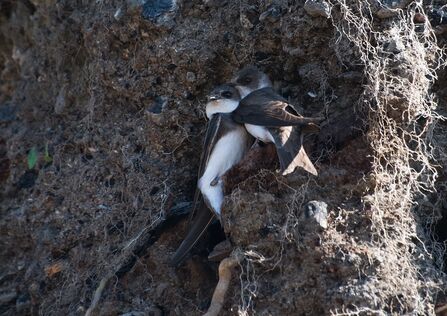
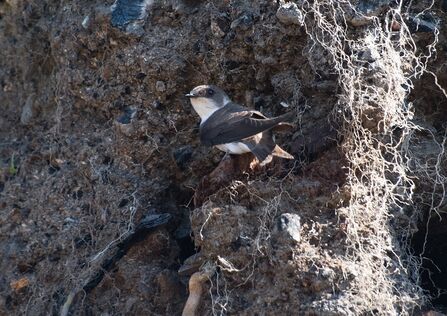
The first of the hirundines are also touching our shores. OK, so I’ve just learnt that word and wanted to impress! This is the name of the group to which swallows, swifts and martins belong. The first to arrive is the sand martin (Riparia riparia). Like their cousins, they are fantastically acrobatic in flight, skimming low over open water to feed on flying insects. After such an epic journey, many of them will be building up the calories over the Somerset levels, before dispersing around the country. 

Sand Martins don’t build cup-shaped nests out of mud like the others, instead they nest in sand or gravel along riverbanks and cliffs. They dig a tunnel and create a space at the end in which to raise their brood. 

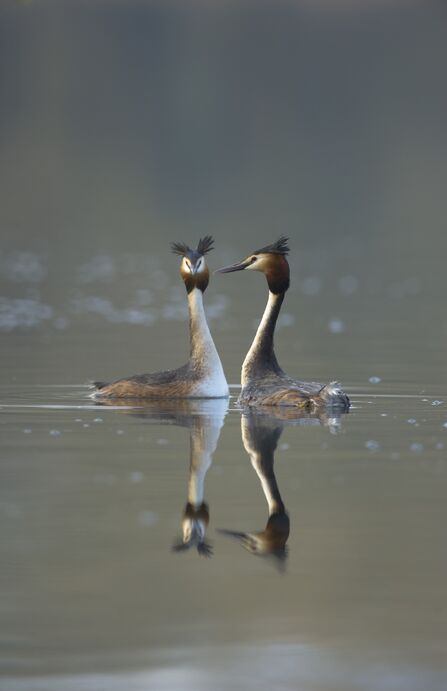
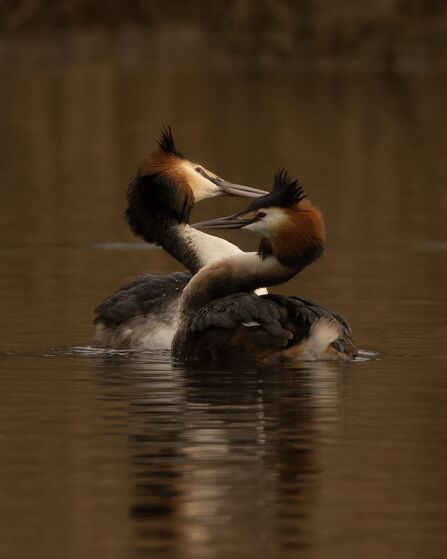
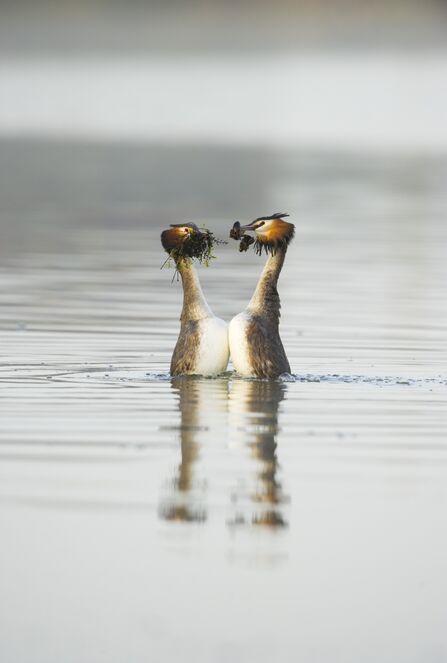
Meanwhile, over at Westhay Moor National Nature Reserve our resident great crested grebes (Podiceps cristatus) are performing their exquisite spring ballet! The full courtship dance involves head shaking, bill-dipping and preening. The grand finale is the famous ‘penguin dance’ when the pair rush together, feet frantically paddling until they are upright, chest to chest, offering each other beakfuls of water weed. Follow their link to see some of the performance and explore YouTube for the full repertoire! 

As well as reaffirming the couple’s bond, the courtship dance and accompanying calls are also a reminder to other grebes nearby that the territory has been claimed.

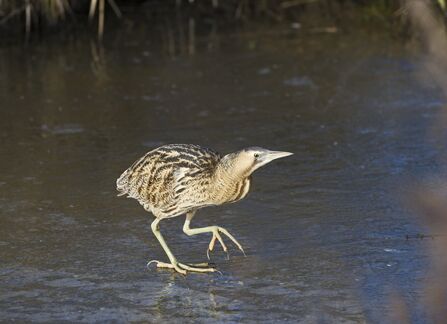
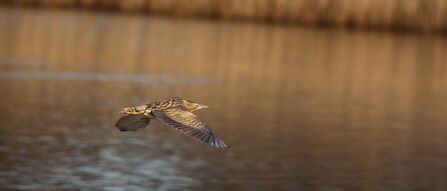
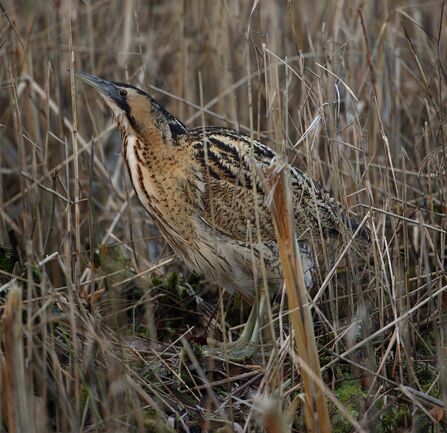
If dancing grebes wasn’t enough, Westhay Moor also boasts booming bitterns! Bitterns (Botaurus stellaris) are shy, secretive birds and they're almost impossible to see as their pale brown plumage blends in perfectly with the surrounding reedbed habitat that they depend upon.

Despite being so elusive, the male bittern is the loudest bird in the UK! The best time to hear him is at dawn or dusk when his deep booms rumble through the reeds and can be heard over two miles away! This foghorn-like call is a serenade to passing females and if they're impressed he might mate with as many as five in a season! His call is also an effective way of marking his territory. To have a listen for yourself visit the RSPB website.

This is also the month of the mad March hare! At dawn or dusk, small groups of brown hares (Lepus europaeus) can be seen quietly grazing in open grassland. Suddenly there is a burst of activity and a chase ensues, followed by a frantic boxing match as two hares rear up and belt each other across the whiskers! Of course - it’s the breeding season!

Two brown hares boxing in open grassland. The hares are close together, facing each other and standing up on their hind limbs, front limbs outstretched and ears upright.

Boxing hares (Lepus europaeus)

Image: Russell Savory

The chasing starts when an amorous male (or buck) decides to try his luck. The female hare (or doe) will try to shake him off if she isn’t ready to mate - but if he doesn’t get the message soon enough, she will turn around and literally box his ears and any other part of him she can reach, until he finally backs down! I’ve been lucky enough to see this spectacle a couple of times out on the Moors towards Meare and it’s amazing to watch!

Brown hares are the UK’s fastest land mammal and can reach speeds of over 40 mph! They were originally thought to have been introduced here by the Romans, but recent carbon dating of hare bones found at archaeological sites now suggests that they arrived in the iron age.  

A brown hare sitting in long dry grass in a field. The sunshine shows up the gold-brown colour of its fur and it sits with ears upright and head slightly turned with one eye towards the camera.

A brown hare (Lepus europaeus)

Image: Jim Higham

Does can have three or four litters of young, known as ‘leverets’, through the season, sometimes as early as March. So, if you happen to come across a tiny leveret huddled quietly in the grass, obviously just give it a wide birth and keep dogs away. It’s usual for mothers to leave them for long periods and return now and then to check on them.

Three brown hares boxing and chasing each other, silhouetted in low light against a grey sky.

Brown hares (Lepus europaeus) boxing and chasing each other.

Image: Mark Hamblin

A common pipistrelle bat emerging from a rocky crevice. It has thick light brown fur, a dark brown face and long ears. It also has its mouth is open showing its tiny sharp teeth.

A common pipistrelle bat (Pipistrellus pipistrellus) emerging from a rocky crevice.

Image: Tom Marshall

Some species of wildlife start to emerge from torpor or hibernation in March. The common pipistrelle (Pipistrellus pipistrellus) is one of the first bats to be seen in spring, sometimes even during daylight hours if they’re hungry, venturing out to catch flies on the wing before retreating to the place where they've been spending the winter. These tiny bats are not fully active until May. 

One sunny afternoon in March a couple of years ago, I saw what I think was a common pipistrelle skimming over the river at Harridge Woods Nature Reserve. Every so often it would rest on a tree trunk, its fur a rich glossy brown in the sunshine, before flitting off again in search of another meal!

A close-up photo of a hedgehog eating dry kitten food from a shallow dish in a garden.

A hedgehog (Erinaceus europaeus) eating a supplementary meal of kitten food.

Image: Gillian Day

Towards the end of the month hedgehogs (Erinaceus europaeus) will be starting to emerge from hibernation, having potentially lost a third of their body weight over winter! If there are hedgehogs in your neighbourhood, you can give them a boost by offering a few extra meals in the evenings. 

Their natural diet includes earthworms, ground beetles, caterpillars and earwigs, but meat-based wet dog or cat foods, or dry kitten food, placed in a shallow dish is safe for them to eat, along with a shallow dish of water. Hedgehogs are lactose intolerant, so please do not give them milk. Also, bread is low in energy so it’s of little benefit to them. Of course, putting food out will probably attract other wild and domestic animals, so for some good advice on how to feed your hogs, pop over to our webpage.

Blackthorn (Prunus spinosa) is one of our first native trees or shrubs to blossom in early spring, often in February. Great white frothy clouds of it deck the hedgerows and woodland edges, providing early insects with much needed pollen and nectar. 

A hedgerow of blackthorn covered in white blossom, with an open area of green grass and daisies in the foreground. The sky above is blue with smudges of white cloud.

A hedgerow of blackthorn (Prunus spinosa) in full bloom.  

Image: Richard Burkmarr

Blackthorn flowers before its leaves appear, which is the opposite way around to most native trees; this includes hawthorn and it’s a helpful way to tell the two of them apart! When it does come into leaf, the foliage is food for the caterpillars of many moths, and those of the rare brown hairstreak butterfly (Thecla betulae), which lays its eggs to overwinter on fresh new growth. These caterpillars make welcome meals for any songbirds nesting in the protection of the thorns, until the tree’s tiny blue-black fruits or ‘sloes’ ripen in the autumn. 

A red admiral butterfly with its characteristic red stripes and white spots on its forewings and red edges to its hindwings, feeding on nectar from white blackthorn blossoms.

A red admiral butterfly (Vanessa atalanta) feeding on nectar from the white blossoms of a blackthorn tree (Prunus spinosa). Most red admirals migrate to the UK later in the spring from North Africa and continental Europe, but some do overwinter here as adults in sheltered places like sheds and garages.

Image: Guy Edwardes

A bumble bee of the species 'early bumble bee', with black and yellow stripes and an orange collar, flying towards purple wild flowers.

An early bumble bee (Bombus pratorum)

Image: Jon Hawkins

The queens of bumble bee species like the white-tailed bumblebee (Bombus lucorum), common carder bee (Bombus pascuorum) and early bumblebee (Bombus pratorum) may already be out and about. In bumblebee colonies, the drones and workers die off in the autumn, leaving the queen to hibernate beneath the soil. In early spring she will re-emerge and build up her strength by drinking nectar from the first wildflowers, before going in search of a new nest site, perhaps favouring an abandoned burrow of even an empty nest box.  She will then focus on creating a new colony, bringing pollen and nectar to her nest to build up reserves before laying her first clutch of eggs.

So, any dandelions, daisies and lesser celandines (Ranunculus ficaria) that you can leave uncut in your garden will be much appreciated!

A close-up photo of a small primrose plant on a woodland floor, with light to dark green leaves and pale yellow flowers. The flowers are a much richer yellow in the centre.

Wild primrose (Primula vulgaris)

Image: Zsuzanna Bird

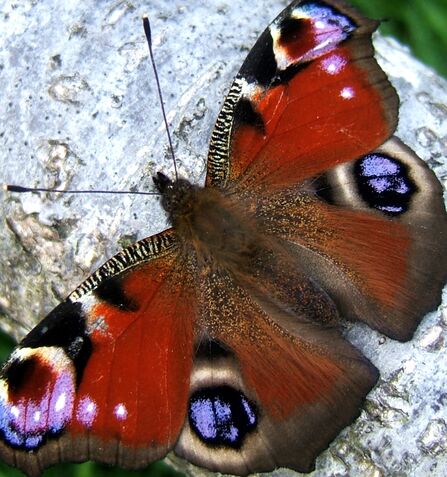
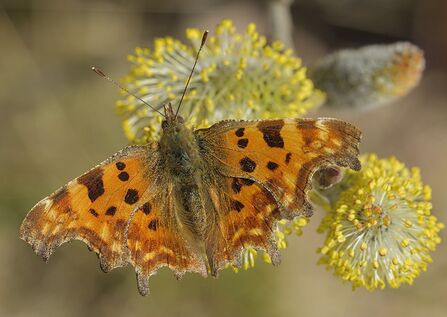
Perhaps nothing says ‘spring’ quite like cheerful clumps of wild primrose (Primula vulgaris). This humble little plant is common throughout the UK, decorating woodlands and grasslands and nestling under hedgerows. It’s another early life saver for many insects, including butterflies like the small tortoiseshell (Aglais urticae), peacock (Aglais io) and comma (Polygonia c-album). These species overwinter as adults, remaining dormant in sheltered spots like tree hollows, sheds or garages, until warm sunny days at the end of winter entice them out to feed. 

A close-up photo of a wood anemone flower. It has numerous white elongated petals and many stick like yellow anthers, their ends tipped with pollen, which protrude from the flower's green centre.

A Wood Anemone flower (Anemone nemorosa).

Image: Philip Precey

Sometime in mid-March the white star shaped flowers of the Wood Anemone (Anemone nemorosa) will be blooming in woodlands, making the most of the dappled light before the tree canopy above grows over. Its seeds are mostly infertile, so it spreads very slowly under the soil through the growth of ‘rhizomes’, which are horizontal underground stems. This makes it a very good indicator of ‘ancient woodland’, because this is woodland that has been left undisturbed with continual tree cover for a long time, at least since 1600. It’s a rare habitat for wildlife, with unique and complex communities of plants, fungi and microorganisms. So, if you come across swathes of white anemones carpeting a wood, you could be walking through a very special place!

Have you ever wondered why early wildflowers are generally white or yellow?

In the low-light conditions of late winter and early spring, white and yellow flowers contrast well against the dark background of soil and winter foliage. This makes them highly visible to early pollinators like some species of fly, which have limited colour vision, and bumble bee queens – who are also rather partial to the colour yellow.  

Also, at a time of year when there is little energy available from sunlight, white and yellow flowers don’t require a lot of energy for plants to produce. 

Natural substances known as ‘carotenoids’ are already present in plants, and they create the colour yellow – as carotenoids are very stable at low temperatures, yellow flowers remain vibrant even on the coldest days!    

White star-shaped wood anemone flowers carpeting the ground on the edge of a woodland, with a few mature trees in the background.

Wood Anemone flowers (Anemone nemorosa) carpeting the edge of an ancient woodland.

Image: Mark Hamblin