January's Winter Wonders

January's Winter Wonders

Red fox (Vulpes vulpes)

Image: Jon Hawkins

Not all of nature sleeps in winter. Now that most of the trees and hedgerows are bare, it’s easier to see the many plants and animals who adapt to the cold and carry on with life as usual. Here are 12 you might spot if you wrap up warm and venture out!

1. Hazel catkins

Here in the South West, hazel catkins are out as early as January. Hazel (Corylus avellana) is common throughout lowland Britain, characterising our hedgerows and woodland edges. You'll know it by the many light-brown or silvery woody stems growing from its base. This small tree has been 'coppiced' by people for millennia, a practice where the stems or 'poles' are cut and harvested every few years. In the past they would have been used to make sheep hurdles or wattle walls for dwellings - these days its pea sticks! Because fresh poles grow again so easily, hazel is also brilliant for hedgelaying.  

Yellow catkins hanging from the branches of a hazel tree. Some of them have stretched out so that their pollen can be released on the wind.

Hazel (Corylus avellana) catkins.

Image: Philip Precey

The tightly packed bunches of catkins become more visible as the leaves fall in autumn and now they are stretching out to hang loosely in the winter sun. Catkins or ‘lambs’ tails’ as they’re often called, are the male flowers of hazel, each one a string of individual flowers releasing pollen on the wind – if you gently flick one, what looks like a little puff of yellow ‘smoke’ will escape! 

A tiny red hazel flower on a twig. It is shaped like a small bud with short. bright red tendrils protruding from the tip.

Hazel (Corylus avellana) flower

Image: Vaughn Matthews

Hazel trees are monoecious (pronounced ‘mon-EE-shuss’), which means each tree has male and female flowers, although they cannot self-pollinate. The female flowers are super tiny! Scaly little buds with what looks like short red tentacles at the tip. These are the ‘styles’ or pollen tubes down which the minute grains of pollen will travel, fertilising the flower to produce fruit – a hazel nut!

Hazelnuts are of course the favourite food of hazel dormice, but they’re also eaten by woodpeckers, nuthatches, tits, wood pigeons, jays and other small mammals.

2. Lichen

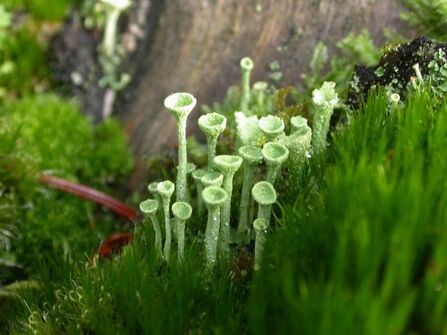
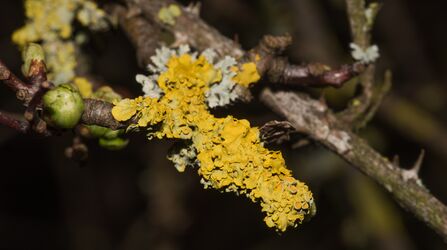
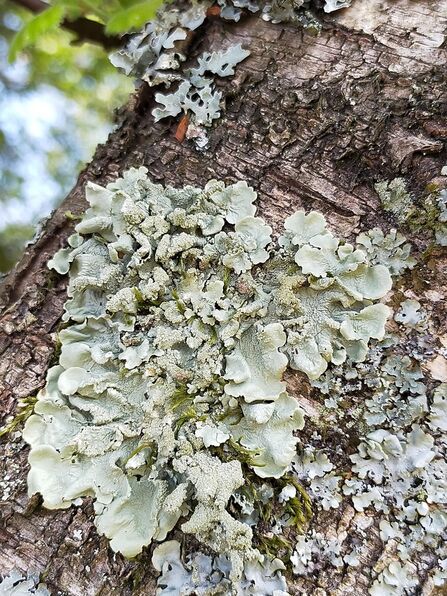
Lichens come in a great variety of shapes and colours, from pale and delicate bushy beards to leafy green pads and bright crusty spots! As they live on tree trunks, branches, rocks and walls they are much easier to see at this time of year when there is less foliage around. Lichens have existed for millions of years and are a combination of 2 or more organisms, living together in a mutually beneficial or ‘symbiotic’ relationship. 

Lichens are made up of a fungus and either algae or cyanobacteria – or both! (Cyanobacteria are a kind of bacteria that can photosynthesise and are the earliest known life forms on earth!). The fungus provides the algae and cyanobacteria with natural material in which to shelter and in return, they provide food for the fungus in the form of natural sugars made by photosynthesis. 

In the UK there are some 1,800 species of lichen, and all of them are non-parasitic, which means they do no harm if they grow on trees. A woodland rich in lichen will support a lot of wildlife, providing nesting material for birds and food and shelter for many tiny invertebrates – which in turn are food for other animals.  

Lichen are also sensitive to pollution – so if there is an absence of them in an area, then the air quality is poor.


A huge clump of frogspawn floating on the surface of a pond in the sunshine, surrounded by green aquatic plants and fallen branches.

Frogspawn floating in a pond in winter.

Image: Nick Upton

3. Frogspawn 

Winter doesn’t seem like the ideal season for breeding, but the common frog (Rana temporaria) is always keen to get on with it! Here in the South West, frogspawn starts appearing from January in shallow ponds, lake edges and even flooded hollows in woodland. Common frogs often return to the pond where they were spawned. Males croak to attract a mate and once he is clasped to her back, she will lay her eggs in the water while he fertilizes them with a spray of sperm. 

The eggs swell and float to the surface, creating the familiar clumps of jelly containing hundreds of little black dots – the tiny frog embryos. But why so many? Frogspawn is a valuable meal in winter for other wildlife, including fish, newts and dragonfly larvae - even rats, foxes and hedgehogs! Only about 1 in 50 eggs will mature into a froglet. Even then, juvenile and adult frogs are food for snakes, birds of prey and mammals such as otters, badgers and weasels. As little as 1% of the original brood may mature and survive long enough to breed! 

4. The Winter moth

Most moths are inactive in winter, but the aptly named winter moth (Operophtera brumata) flies from October to January, able to cope with freezing temperatures. You might be lucky enough to find a male resting on a tree trunk, but they’re more commonly seen on the outside of your windows at night when you switch on the lights, or caught in the beams of your car headlights. 

A winter moth resting on the bark of a tree; the light brown bark contrasting the waves of light and dark grey, and dark brown, across the moth's wings and the cream coloured wing tips.

Winter moth (Operophtera brumata)

Image: Vaughn Matthews

The males are small; their broad triangular wings are grey or pale brown with subtle wavy bands. The females look nothing like a moth! Instead, they resemble a small bug with such short wings that they are unable to fly. To attract a mate, they climb the trunk of a broad-leaved tree and give off pheromones, which the males find irresistible. 

Eggs are laid safely in cracks in the bark and the tiny green caterpillars hatch in spring - you can spot them dangling from the branches on silken threads, letting the breeze carry them from tree to tree as they search for fresh new leaves to munch on. 

Blue and great tits rely so heavily on these caterpillars as food for their chicks that their breeding season coincides with the time when they hatch! 

5. Great spotted woodpecker

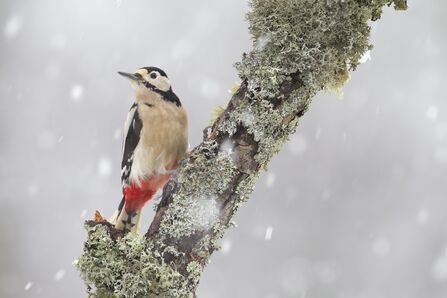
If you want to see a great spotted woodpecker (Dendrocopos major), set up a bird feeding station in your garden. Watching one land clumsily on the nut feeder, scattering angry blue tits in all directions is hilarious!

This beautiful bird is the UK’s most common woodpecker. It’s about the size of a blackbird, with black and white plumage, apart from a bright red patch under the tail. Males also have little red patches on the back of their heads. (It's not to be confused with the lesser spotted woodpecker (Dryobates minor), which has distinctive white stripes on its back and is rarer and much smaller - about the size of a sparrow). 

Their natural habitat is broad-leaved woodland, but they will live in parks and gardens – anywhere where there are plenty of mature trees. Although they will gratefully tuck into any nuts and seeds that we have to offer in winter, they spend the rest of the year eating insects and insect larvae - they use their thick powerful beaks to hammer holes in tree bark and extract them with their long sticky tongues.  They will also probe the nests of smaller birds hidden in tree cavities and take their eggs and chicks in springtime. 

The drumming sound that we associate with them is most noticeable in spring during the breeding season, when males hammer against dead trees as a declaration of territorial ownership and a warning to other males to stay away! The skull of this bird has evolved to absorb the shock of this continual impact, so efficiently in fact that scientists have studied it to improve the design of protective headgear for humans!

The great spotted woodpecker is less visible the rest of the year, but you may hear its distinctive ‘chip! chip!’ call when walking through a park or woodland. If you accidentally disturb one, it will quickly fly away, dipping through the air as it goes.

6. Short-eared owl

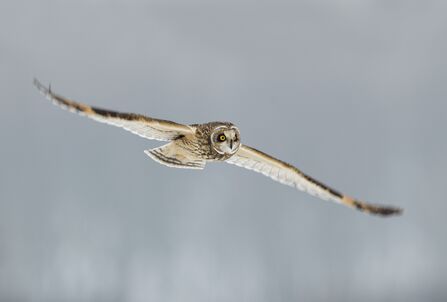
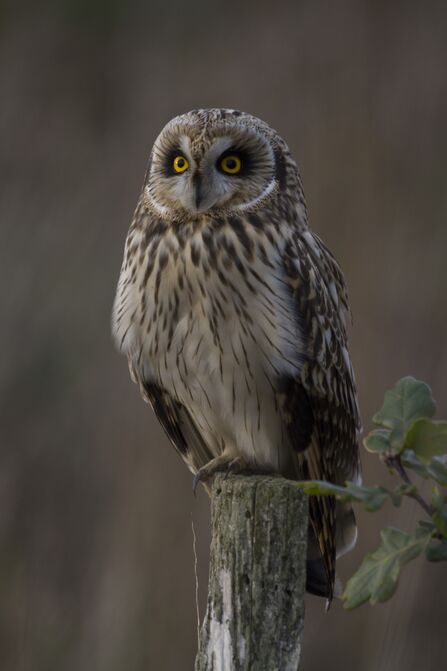
Short-eared owls (Asio flammeus) are a winter treat for us folks in Somerset! Any we might see have probably travelled south to avoid the short, bitterly cold days in Scotland and Northern England, or even Scandinavia, Russia and Iceland. These owls appreciate a little more daylight as unusually; they are daytime flyers. This hopefully gives us a good chance of seeing one, although they are well camouflaged, with mottled brown plumage and pale underwings, and tend to fly low as they hunt over marshes and wetlands looking for field voles and small birds.

However, if you keep your eyes peeled (and maybe have a good pair of binoculars!) you may see one perched on a fence post. They’re about the size of a barn owl and what makes them distinctive is the dark circles around their yellow eyes and of course, what appears to be a lack of ear tufts. However, the tufts are still there, they’re just very small and lie flat against the head most of the time. They are only raised when the owl is alarmed or wants to make itself look bigger. Their actual ears are tucked away on either side of their head.

In the spring, these striking birds return to their home turf to breed on moorlands and rough grasslands.


Clumps of snowdrops in full bloom stretching from the foreground backwards, across a meadow, to a copse of trees.

Snowdrops (Galanthus nivalis)

Image: Sadie McGlone

7. Snowdrops

Snowdrops (Galanthus nivalis) are the first woodland and meadow flower of the year and a cheerful promise of brighter days to come! Here in the South West they flower from January to March and can be found just about anywhere there is damp soil, including our parks and gardens. 

Although they feel very much like they belong, snowdrops are not technically native to Britain. They originate in mainland Europe, though no one knows exactly when they arrived here. It’s thought they may have been brought over as an ornamental plant for gardens in the 16th Century and escaped into the wild – the earliest recordings of them in the countryside only date back as far as the 18th Century. 

Anyway, who cares?! Clumps of snow drops carpeting the winter woods and riverbanks are a joy to see! They also offer a lifesaving drink of nectar to any bumble bees woken from hibernation by the winter sunshine. However, its too early in the year for them to rely on pollinating insects, so as any keen gardener knows, snowdrops spread by bulb division under the soil.

A Brimstone butterfly resting on a dried brown leaf with its wings folded behind its back. The wings themselves are shaped like leaves and the underside of them is pale green and heavily veined, adding to the camouflage effect.                                  . The  and shaped distinctly like a pair of leavesed

Brimstone butterfly (Gonepteryx rhamni)

Image: Neil Phillips

8. Brimstone butterfly

The Brimstone butterfly (Gonepteryx rhamni) overwinters as an adult in a dormant state a bit like hibernation; its bodily processes slow and it remains inactive in a sheltered spot during cold weather. However, its not uncommon to see one even in January if we get a spell of warmer weather and plenty of sunshine.  Like the Small Tortoiseshell and Peacock who also over winter as adults, Brimstone butterflies store glycerol in their bodily fluids, which acts as a sort of antifreeze and prevents them from freezing when the temperature drops below 0°C! 

Brimstones are large butterflies, with wings that closely resemble heavily veined leaves. They always settle with them closed, as the shape of their wings provides good camouflage. The wings of males are bright yellow above and a paler greenish yellow underneath, whereas the wings of females range from pale green to almost white. Both have a small orange spot on each wing.  

Sadly, Brimstones aren’t common, perhaps because their caterpillar foodplants, purging buckthorn (Rhamnus cathartica) and alder buckthorn (Frangula alnus) aren’t common either. But they are long lived for butterflies, surviving for up to a year as adults. Generally, a good place to spot them is scrubby grassland or along hedgerows and woodland rides – they are particularly attracted to blue and purple flowers, so in the spring you might see one enjoying at feast of nectar amongst the bluebells! 

An adult red fox sniffing the ground as it walks towards the camera across a green, surrounded by trees in winter.

Red fox (Vulpes vulpes)

Image: Luke Massey

9. Red fox

This is not so much about seeing red foxes (Vulpes vulpes), as hearing them! January is the peak of their breeding season and whether you live in a town or the country, this is the month you might be woken in the dead of night by the most terrifying screams! (To me it sounds horribly like an animal in distress!) But this unnerving cry is just the mating call of the vixen, letting neighbouring males know that she's ready to mate. Her screams are often answered by a ‘hup-hup-hup’ bark of a dog fox.

In February pregnant females start to search for a potential den, clearing out old sites in earthen banks in the countryside or in waste ground and under sheds in urban areas, before they finally choose one in which to give birth. 

Cubs are born in March, blind, deaf and unable to regulate their own body temperature, so for the first couple of weeks they stay snug and safe with their mother inside the den. She is brought food supplies by her mate and other members of the family group, who are adult females from her previous litters. By late April, the cubs are eating solid food and are ready to venture out of the family home. 

10. Common polypody fern

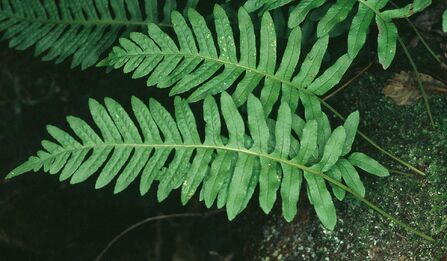
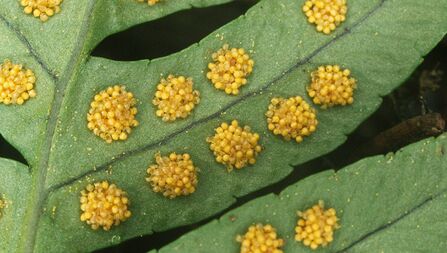
The common polypody (Polypodium vulgare) is a medium sized fern which grows all year round, bringing a welcome dash of green to winter woodland. Like all ferns, it's an ancient organism – a survivor from the time of the dinosaurs. Its leaves are divided into many individual finger-like fronds, which are dotted underneath with small circular structures of yellow or orange. These produce and release millions of tiny spores in the summertime.

The common polypody loves damp woodland and can be found clinging to rocks and steep shady banks, often beside running water, creating a rainforest feel. It is also an ‘epiphyte’ – a plant that grows on others for support. It commonly inhabits the mossy nooks and branches of old oaks trees, collecting moisture and nutrients from the rain and natural debris that gather there. 

11. Lapwing 

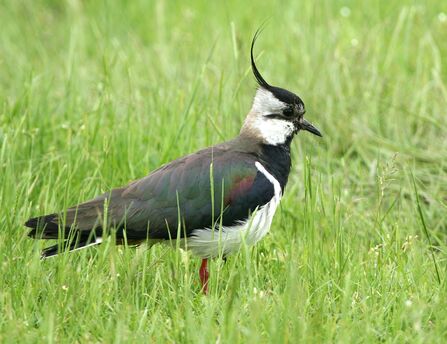
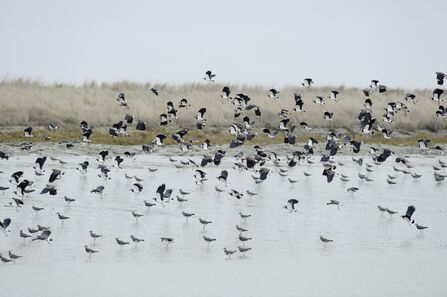
Lapwings (Vanellus vanellus) are mostly winter visitors to Somerset, arriving here from the rest of the UK and mainland Europe. They gather in flocks to feed on the peat moors and wet grasslands, as well as the coastal mudflats at low tide, poking about for earthworms or insects and their larvae.

At a distance their plumage appears black and white, but a closer view (perhaps with binoculars!) will show you the beautiful flashes of red, green and purple on their iridescent wings, as well as their handsome crests. 

The name ‘lapwing’ is thought to derive from an Old English term meaning 'leap with a flicker in it' because the dense winter flocks appear to flicker between black and white as the birds take off. They're also known as the ‘peewit’ after one of their high-pitched squeaky calls!

Lapwings used to be a common sight in Britain, but their numbers have dropped by over 50% since the 1960’s as increasingly mechanised and intensive agriculture has steadily destroyed their nesting habitat. In spring, the flocks disperse as most of the birds return to their breeding grounds, but since Somerset Wildlife Trust completed the peat moors restoration project at Westhay National Nature Reserve, we now have pairs of lapwings remaining there to breed! 

12. Roe deer

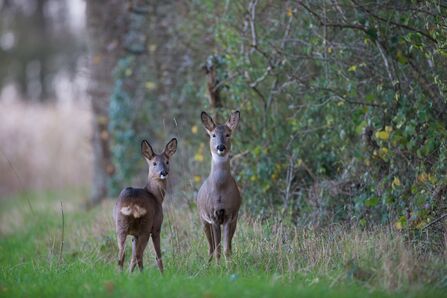
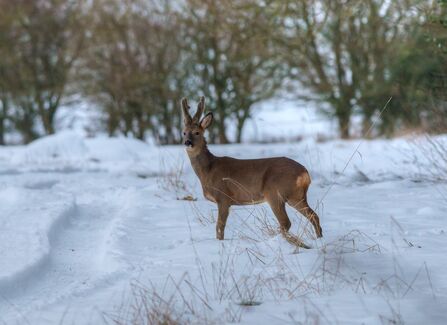
If you wander quietly through a wood in Somerset at any time of the year, you always have a good chance of seeing roe deer (Capreolus capreolus); perhaps a solitary male or ‘buck’ with short antlers and a shiny black nose, munching on herbs and new tree shoots. They’re also a common sight in fields along woodland edges on summer evenings, maybe a grazing female or ‘doe’ and her offspring, their coats gleaming reddish brown in the late sun.

In winter, roe deer band together in little groups and their coats fade to grey-brown, in harmony with the muted colours of the surrounding countryside. If they see you, they may stare for a moment before lightly bounding away with a flash of their white rumps! At this time of year, any foliage is a welcome meal, including bramble and ivy leaves and even those of holly, if they can reach any without the prickles! 

Roe deer and the magnificent red deer are our only native deer species, and the roes can be found all over mainland Britain, particularly in Scotland and the south. Once hunted by wolves and lynx, they no longer have any natural predators and currently their numbers are at an all-time high. This means that occasionally, some populations are culled so that their grazing makes less of an impact where the natural regeneration of woodland habitat is being encouraged for the benefit of other wildlife.