
This month something wonderful is happening in the comfort of a warm burrow – badger cubs are being born!
February - prelude to spring!

Snowdrops (Galanthus nivalis)
Image: Sadie McGlone
Winter has battered us with storms and floods and you wonder if the rain is ever going to end! But as the daylight stretches, nature can feel the approach of spring and wildlife is getting ready!

A European badger (Meles meles)
Image: Jon Hawkins
The European badger (Meles meles) is the UK’s biggest land predator and of course, the beloved emblem of the Wildlife Trusts. They’re chunky beasts, with adults weighing in at 10kg –12kg! And although they are common throughout the UK, the highest numbers are down here in the south.
Badgers live in big family groups of four to seven individuals and their main residence is a large, complex burrow known as ‘sett’. This is usually situated in the shelter of a broad-leaved copse or woodland with easy access to open countryside. A family may use the same sett for many generations, and they are excellent house-keepers – you’ll know if a sett is occupied because the entrances will be swept clean. They are particularly conscious of parasites, and will regularly change their bedding, discarding piles of old dry grass and leaves outside. They even dig a separate pit away from the sett to use as a toilet.

European badger (Meles meles)
Image: Russell Savory
Badgers spend most of the winter tucked up at home away from the cold, surviving on their fat reserves in a state of ‘torpor’ rather than hibernation. Their metabolism, heart and respiratory rates slow, enabling them to conserve energy when there is little food available. But if they do get hungry, they will go out to forage.
Female badgers are known as ‘sows’ (males as ‘boars’) and they are pregnant usually from December to January, with most cubs being born in February. When she is ready to give birth, a sow will select a roomy chamber in the sett which is situated near the entrance for good ventilation. She will usually give birth to one or two cubs, but as many as five is not uncommon! Cubs are born weighing as little as 75g – 130g, their eyes and ear canals are closed and they have only a light covering of fur.
Frustratingly for sows, they come into season, technically known as ‘oestrus’ (pronounced ‘EE-struhs’), straight after giving birth. So most mating also occurs in February! However, like many mammals, a female badger can ‘delay implantation’ which means fertilised eggs remain undeveloped in her womb until the following mid-winter. Then the short day-length triggers hormonal changes in her body and the pregnancy really begins. This clever biological strategy ensures that by the time cubs are mature enough to venture outside, spring has arrived and with it warmer weather and plenty of food.
Cubs reach adult hood in about a year and then some will stay with the family group while others leave to find new territory.
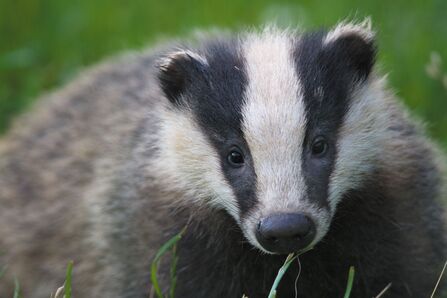
Badger cub (Meles meles)
Image: Bertie Gregory/2020VISION

A badger track in mud.
Image: Philip Precey
Badgers are nocturnal, but on long summer evenings they may emerge a short while before sunset. They are expert foragers, using their keen sense of smell to locate food and their strong paws and sharp claws to unearth their favourite delicacy – earthworms! About 80% of their diet is earthworms and they can eat hundreds in a single night! Badgers are omnivores, which means their diet is varied and they have BIG appetites: fruit, bulbs (including my tulip bulbs), bird’s eggs, nuts and acorns are all on the menu, including plenty of slugs and other invertebrates.
If earthworms are scarce, they will hunt small mammals like mice and rats, as well as frogs and toads – and they are the main natural predator of hedgehogs. Because of their thick skin and powerful claws, they are one of the few animals who can get past those protective prickles.
Badgers can occasionally be found living in urban areas if there is enough cover for a sett and open green space in which they can hunt and forage.

European Badger (Meles meles)
Image: Terry Whittaker
February is also an important month for the common toad (Bufo bufo). From now until early April, depending on weather and local climate, thousands of toads will make their annual migration back to the pond where they first began life - in other words, where they were ‘spawned’. They always follow the same familiar route, tackle any obstacles in their path and sometimes travel as far as a kilometre, so strong is the instinct to find a mate and reproduce.
For most of the year toads live a solitary life away from water. Instead, they inhabit damp shady places in woodland and rough grassland, or under hedgerows and compost heaps. They don’t hibernate in winter either but remain safely buried in soft mud or underneath leaf litter and dead wood, coming out to forage when the weather is milder.

Common toad (Bufo bufo)
Image: Joy Russell
Toads are mostly active at night, hunting for a variety of invertebrates including slugs, spiders, worms and ants - sneaking up on their prey and catching it with their long sticky tongues. Adult females are larger than males and some can be as long as 13cm! These handsome beasts are formidable enough to hunt harvest mice and slow worms - even younger toads!
Common toads are distinguishable from common frogs by their dry, warty skin. If a toad feels threatened it will puff up and the warts will secrete a fowl tasting toxin as a defence against predators! They also move differently- toads walk or crawl, whereas frogs hop.

Common toads have dry warty skin and golden eyes with horizontal pupils.
Image: Joy Russell
The busiest migrations occur on damp nights when the temperature is above 5°C. Males tend to arrive at a pond first and when the females turn up there is fierce competition amongst them to claim a mate and jump on her back. Of course, there are always those who cheat and some males will climb onto a female on route if they get the chance! During the breeding season, male toads develop rough pads on their fingers called ‘nuptial pads’. These enable them to firmly grip their partner in a mating embrace known as ‘amplexus’.
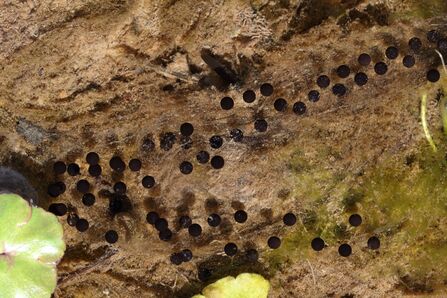
Double strands of common toad spawn wrapped around aquatic plants in a pond.
Image: Vaughn Matthews
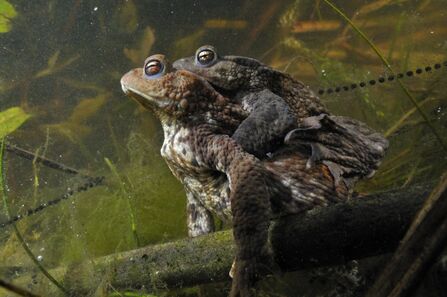
A pair of common toads in amplexus surrounded by strands of toad spawn.
Image: Linda Pitkin
Toad spawn looks different to jellied clumps of frogspawn; toads mate in deeper water than frogs and females spawn double strands of eggs which they wrap around aquatic plants as their partner fertilizes them. A single female will produce around 1,500 eggs – a guarantee that at least some of her offspring will survive to maturity. Although toad tadpoles can secrete the same toxin as their parents, they still have many predators including dragonfly larvae, the common backswimmer (Notonecta glauca) and fish. Young toads are also a meal for grass snakes and herons, as well as otters, hedgehogs, foxes and badgers.
The tadpoles hatch after about 10 days and spend the next 16 weeks or so feasting on algae and other plant matter, gradually losing their tails and developing legs, until they emerge from the pond as young toadlets.

Common toad (Bufo bufo) tadpoles.
Image: Vaughn Matthews
The bad news is that common toad populations have nearly halved in the past 40 years. There are many possible reasons for this, including loss of pond and wetland habitat, increased urbanisation and a decline in invertebrate prey. But road mortality is considered a major issue - an increasing number of toads are killed by traffic every year in early spring as they attempt to travel to their breeding ponds.
However, there is hope. Over 20 years ago the amphibian and reptile conservation charity ‘froglife’ began their ‘Toads on Roads’ project. Volunteers meet on wet, mild evenings at points where toad migration routes cross busy roads and gather up as many toads as they can find (and sometimes frogs and newts!) and carry them safely across in buckets.

A toad crossing warning sign.
Image: Linda Pitkin
There are now many of these 'toad patrols' across Britain and you may have seen the warning signs. Furthermore, these patrols are an opportunity to record data, so that conservationists can see how different populations are faring and where help is most needed. If you would like to volunteer to help, follow our link to the froglife website to find your nearest toad crossing.
Male song birds are already tuning up as the time to defend territory and attract a mate rapidly approaches. I live on the Mendips, and two bird songs I'm hearing a lot at the moment belong to the song thrush (Turdus philomelos) and great tit (Parus major)- both of them are known to start singing early in the year. If you're not sure what they sound like, our song thrush link has a recording at the bottom of the page and you can listen to the great tit on the RSPB website here.
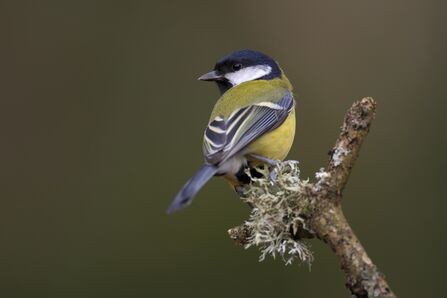
Great tit (Parus major)
Image: Jon Hawkins
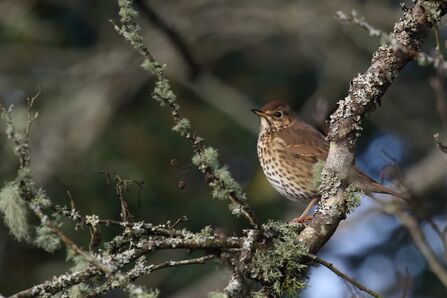
Song thrush (Turdus philomelos)
Image: Vaughn Matthews
One of my favourite birds to look out for in winter is the pied wagtail (Motacilla alba yarrellii), perhaps because I love the way they ‘speed walk’ - scooting rapidly across a car park or down my garden path!

A pied wagtail (Moticilla alba yarrellii)
Image: Jon Hawkins
Aptly named for their contrasting black and white plumage and long bobbing tail, pied wagtails are a common sight in urban areas all year round, and in winter many of them are attracted to gardens by the offer of seed at bird tables and scraps of food dropped in the street. Our resident birds here in the South West are also joined by migrants escaping the harsher weather in upland areas of the north.

Pied wagtail (Moticilla alba yarrellii)
Image: Janet Packham
At dusk, large flocks gather to roost, sometimes in their thousands! This is common in city centres where the heat escaping from buildings raises the air temperature by a few degrees. This is an important consideration when you’re a small bird with a relatively large surface area and you can lose body heat quickly. There is also safety in numbers, and birds over wintering near wetlands will roost in reed beds where the water acts as a safe barrier against predators.
When spring arrives, so does their preferred diet of insects and for these they will go further afield. A good place to forage for insects and their larvae is around water, so it’s not surprising that pied wagtails LOVE sewage farms! After all, where there’s muck - there’s flies! But they will still hunt for beetles and spiders in cracks along pavements and amongst roof tiles. I also see them regularly strutting across my local playing field in search of bugs!

In the warmer months, pied wagtails spend a lot of time around fresh water where insects are abundant.
Image: Tom Hibbert
They are resourceful and adaptable, and like robins, they will nest just about anywhere - in tree hollows, under roofs and in walls, in abandoned machinery, cars and greenhouses!
The pied wagtail is a sub-species of the white wagtail (Moticilla alba), which means it is a variation, most noticeably in the plumage. White wagtails are much paler than our native birds, and in spring we get flocks of them stopping over on their migration from Africa and southern Europe to their breeding grounds, in the Faroe Islands, Iceland and Greenland. They make an appearance again on their return journey in the autumn.
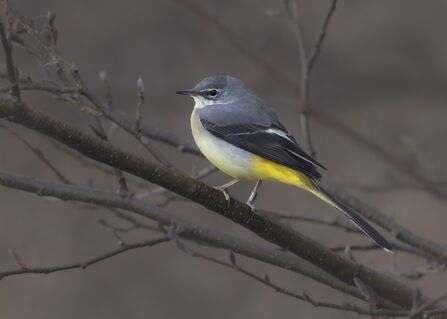
Grey wagtail (Motacilla cinerea)
Image: Jon Hawkins
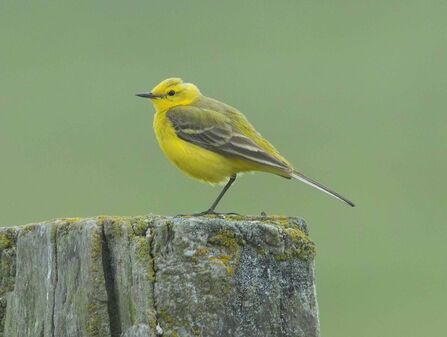
Yellow wagtail (Motacilla flava)
Image: Derek Moore
But why the wagging tail? Like its cousins the grey wagtail (Motacilla cinerea) and yellow wagtail (Motacilla flava), the pied wagtail spends a lot of time at ground level or in shallow water, so the most popular theory is that the bobbing tail gives potential predators the impression that they are alert and ready to take off - and not worth the effort of hunting!