

What's next for Honeygar?
Our aim is for the buildings at Honeygar to become an internationally recognised hub for research, innovation and collaboration in lowland peatland restoration.
Next steps at Honeygar
Our aim is for the buildings at Honeygar to become an internationally recognised hub for research, innovation and collaboration in lowland peatland restoration.
We have now (February 2026) submitted a planning application for proposals to create a research centre, marking an important step in the long-term future of the site.
The application supports the next phase of work at Honeygar: the sensitive conversion and redevelopment of existing farm buildings to create a nationally significant, world-leading research and teaching facility focused on lowland peatland restoration. The proposals are designed to support research, learning and collaboration that will help address urgent challenges including climate change, water quality, flood risk, food security and biodiversity loss related to lowland peatlands.
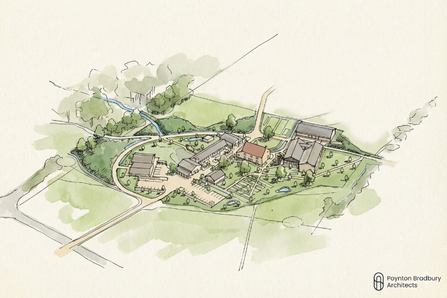
Honeygar masterplan illustration

Honeygar from above. Image: Michael Holman, Red Forge Studios
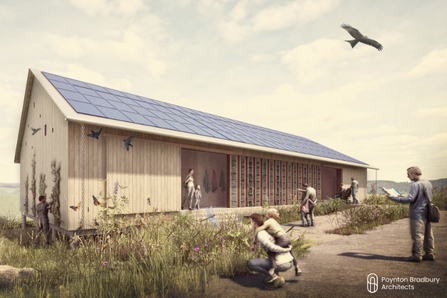
Honeygar-Building D
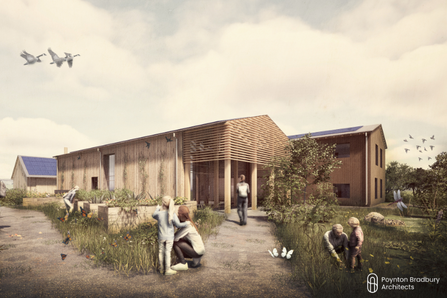
Honeygar: Buildings C & E
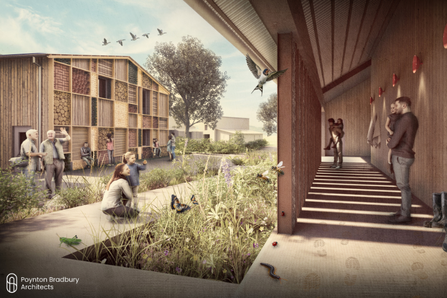
Honeygar: Building D illustration
Our vision
The core plan includes wet and dry laboratories for in-situ research, complemented by office space, exhibition/community areas, and flexible meeting and teaching spaces.
Based on feedback from academic institutions, we also propose onsite accommodation to address Honeygar’s remote location, support field study groups, and meet the needs of postgraduate researchers. Additional facilities will include catering, caretaker housing, workshops, and storage.
Designed in consultation with communities, local people will benefit from enhanced public access along a circular walk with viewing areas and public toilets. The plans also include spaces to hire and the restoration of the existing orchard for community benefit using traditional techniques and local species.
The scheme also includes a variety of indoor spaces available to hire, ranging from small meeting rooms for four people to a hall with kitchen and bar with a capacity of seventy.
The existing orchard will be restored and remain accessible to the public, with a selection of traditional Somerset apples available for eating, cooking, juicing and cider-making.
This next stage in Honeygar’s history will provide real benefits to Somerset in addition to finding those solutions, boosting the economy through the use of local contractors and businesses both in construction and operation, creating jobs and providing a wide range of training opportunities. We’re really excited about this next step in our plans for HoneygarCEO, Somerset Wildlife Trust

Science and Research at Honeygar
Working with academics, universities and local specialists we now have an established baseline for biodiversity, soil types, water quality and for greenhouse gas emissions for Honeygar.

Kirby Everett
Restoring ecosystems
This is the first site we’ve bought with the view to allowing nature to recover without setting specific habitat or species objectives.

Image: Emily Weatherburn
Westhay Moor
Most of Westhay Moor is reed bed created from peat voids left as a result of industrial peat extraction where all the peat has been removed.
Back to main Honeygar page...
Honeygar
Honeygar sits between our existing nature reserves of Westhay Moor, Catcott Complex and land we manage on Tealham and Tadham, all with large elements of lowland peat.