
Since agricultural intensification in the latter half of the 20th century, this process has led to the loss of large areas of marginal grazing land.
These same marginal areas also tend to be the only farmland in the UK that has never been ploughed or artificially fertilised, meaning it has the potential to be extremely species rich - so it is often worth the effort to manage the bracken to restore these habitats to their former glory.
Why we manage bracken to restore species-rich grasslands

Image: Vaughn Matthews
Bracken is one of the main threats to species rich grassland habitats, as it can quickly develop into dense stands that smother grasses and wildflowers.

Image: Chris Eyles
On one of our Mendip reserves, areas of species-rich limestone grassland had gradually become dominated by bracken. Since acquiring the site, we have been managing the bracken by cutting and raking, flailing, or rolling to restore this priority habitat. Those areas we have been focussing on now display a rich ground flora, with abundant pyramidal orchids, rock rose, lady’s bedstraw, wild thyme and dropwort. Some of the particularly dry and rocky areas also contain patches of common centaury, one of my favourite wildflowers.
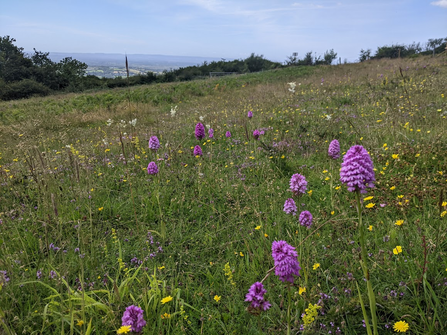
Image: Chris Eyles
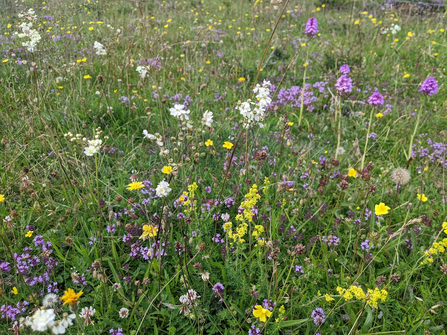
Image: Chris Eyles
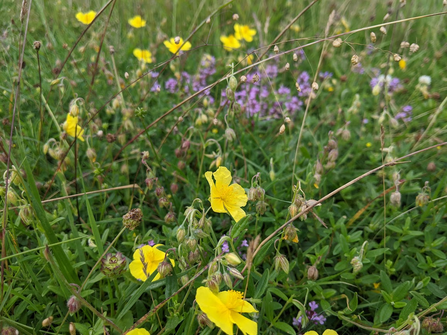
Image: Chris Eyles
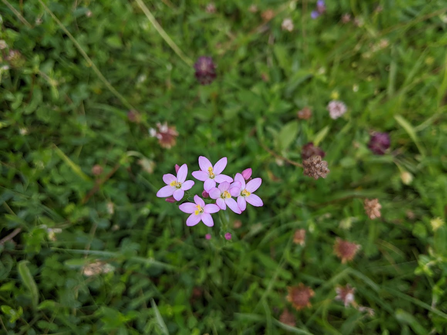
Image: Chris Eyles
As we manage the bracken year on year, it gradually becomes less dense, allowing grasses and wildflowers to flourish. This also means that it takes less time to manage, so we can gradually expand the areas we work on over the years. Areas where we have only recently been controlling bracken growth are currently displaying dense growth of wild marjoram amongst the remaining bracken, representing a transitional phase in the restoration of this habitat.

Image: Chris Eyles
An efficient way to manage bracken is to use a tow-along flail mower or bracken roller mounted behind a quad bike or 4x4. Using a flail will mulch the bracken, preventing it from smothering future growth of grasses and wildflowers, and is a good option for dense stands of bracken. If using a flail, it’s best to have livestock graze down the sward beforehand to avoid mulching large quantities of grass, which will act as a fertiliser, favouring development of coarser grasses over wildflowers in future years. Using a roller will instead crush the bracken and will have much less impact on other flowering plants present in the sward, so is a great option for slightly more sparse areas of bracken.
Many species rich grasslands have numerous large ant hills, or areas of very rough, steep, or rocky terrain that is not suitable for vehicle access. For these areas, we brush cut the bracken by hand, and then rake off the cut stems to avoid them smothering future growth.
As with any grassland habitat, maintenance of a good conservation grazing regime is also essential to maintain a balance between grasses and flowering plants with a broad range of micro-habitats for butterflies, grasshoppers, reptiles & small mammals.
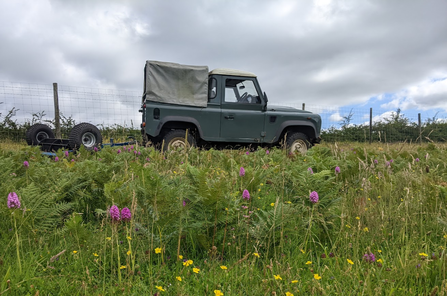
Image: Chris Eyles
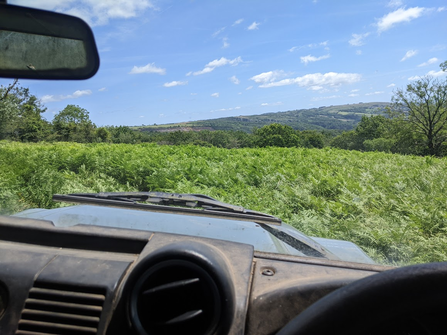
Image: Chris Eyles
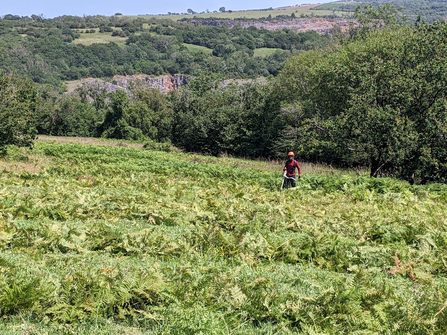
Image: Chris Eyles
It’s quite labour intensive work, but looking at the difference between the pictures of the areas of dense bracken and the stunning displays of wildflowers in areas of restored habitat, I think you’ll understand why I find it one of the most satisfying management tasks we do on our Mendip reserves.
Restoring species-rich grasslands is just one of the many ways Somerset Wildlife Trust is helping nature recover across the county.