

Chancellor's Farm from the air. Image: Flying Tiger
Chancellor's Farm
Set in the heart of the Mendip Hills is a place of quiet beauty, deep history, and rich wildlife.
Why is Chancellor's Farm so special?
Chancellor’s Farm is more than a nature reserve – it’s a remarkable place where every meadow, wildflower and drystone wall tells a story, shaped by centuries of low-intensity, traditional farming and careful management.
Somerset Wildlife Trust has managed the site for over 30 years, and this 18th century working farm is now one of the few places in the UK where thriving wildflower-rich hay meadows can be seen. This rare and declining habitat is essential for biodiversity and increasingly important given that 97% of meadows in the UK have been lost since 1930s.
Chancellor's Farm - Wildflowers (https://youtu.be/Cf87j7yJkY0)
Filmed by Flying Tiger
The story so far
Designated a Site of Special Scientific Interest (SSSI) in 1983, the farm’s association with nature-friendly practices goes back generations. Prior to the Trust, the farm was previously managed by the Watts family, who worked the land without chemicals or artificial fertilisers. Their low-intensity approach preserved the rich diversity of the meadows - still cut and stacked by hand well into the 1980s.
Since 1991, Kate Lawrence has overseen its careful management, later introducing ruby red Devon cows, Welsh black mountain sheep and Exmoor ponies to help maintain the delicate balance of the grassland. Before managing the farm, Kate was the Mendip Hills Officer for Somerset Wildlife Trust.
Nature on the site
A flagship Coronation Meadow – one of only 60 across the UK – Chancellor’s is an outstanding example of how land can be productive and be managed in a nature-positive way.
Chancellor’s Farm is particularly special, with an unusual mix of lime-rich, neutral, and acidic soils. This diversity allows a remarkable range of plant species to thrive, from fragrant orchids and meadow saffron, to betony and devil’s-bit scabious.
On Chancellor's Farm, the species rich hay meadows are extremely important for wildlife and, since 2009, we have been collecting systematic botanical data to monitor the condition of the meadows. This allows us to assess whether our management of the site is successful at maintaining the quality and diversity of these rare botanical communities.Reserves Monitoring and Management Planning Officer
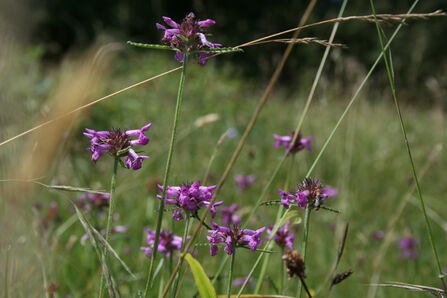
Betony - Cath Shellswell
Connection to the wider Mendip Hills National Landscape
Important too is Chancellor’s connection to the wider Mendip Hills National Landscape through its neighbouring grasslands sites. This connection not only provides the pathways for other county sites to receive its donor seed, but links the site into the ‘Big Chalk’ network - a network of significant chalk and limestone landscapes covering over 25,900km2 across the south of England. This provides added resilience in the face of a changing climate, as well as protecting valuable historic heritage and water supplies, storing carbon, enhancing natural beauty and helping to improve health and wellbeing.
Recently we headed to the farm to learn why dry stone walls are an important part of Chancellor’s Farm’s history – and we found out that they’re absolutely full of surprises! Our dry stone walling volunteers have uncovered fossils, old bones and even slow worms sheltering beneath the stones. Watch the mini film here!
Chancellor's Farm - Dry stone walls (https://youtu.be/Q0nbSdq7wCo)
Filmed by Flying Tiger
Ancient hay meadows are a remarkable habitat in the British countryside. Having escaped the use of modern farming methods such as artificial fertilisers, they are home to plants such as adders tongue fern and autumn crocus which only survive in these types of grasslands making places like Chancellor’s Farm an irreplaceable source of biodiversity which must be protected.Reserves Manager – Central Mendip
Make hay while the sun shines goes the old saying, and we certainly had plenty of sun this summer. The annual hay cut is a practice that has been happening at Chancellor’s Farm for generations and is essential to the reason it is still such an incredible haven for wildlife. In the past, the reason to cut the hay was to feed livestock during the winter months, although this is still somewhat the case, now the primary reason is to preserve the amazing variety of wildflowers in the meadows.
The hay cut removes nutrients from the fields and as the wildflowers at Chancellor’s thrive in nutrient poor soils, by removing the hay we are exporting nitrogen and phosphorous keeping soil fertility low and prevents competitive grasses from taking over. Timing is crucial when it comes to cutting the meadows. We always cut in mid to late summer when the wildflowers have set seed and enable the flowers to rejuvenate the following year and allows ground nesting birds to nest in the fields.
The process of making hay is very simple. The fields are cut and left to dry for as many days as is necessary. The hay is often turned at least once to ensure the hay dries evenly and serves the purpose of shaking the seed from the drying grass. While it’s a busy time of year and can be hard work getting the hay cut and baled hay in the barns, we are proud to play our part in preserving the traditional methods that allow the wildflowers to thrive and all the wildlife that depend on them. - James Ozolins

